Theory, design, research,and use of historical games in and beyond history education. Look here for links to current research, lists of available historical video games, reviews, and essays on a variety of topics connected to historical games. Created and maintained by Jeremiah McCall (jmc.hst@gmail.com;
@gamingthepast.bsky.social;
@gamingthepast@hcommons.social)
, teacher, historian, game designer, historical game studies person, and author of Gaming the Past, Second Edition
See the home page for essays and news on historical games.
Browse the content pages for articles and links to historical games.
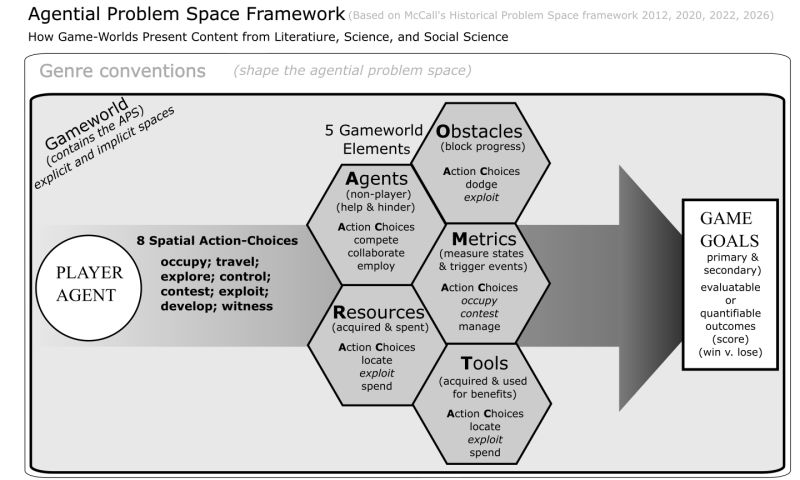
This is a quick post just to start a conversation and/or further work. It might be useful to notice all games with worlds can likely be helpfully be analyzed as Agential Problem Spaces, building off of the Historical Problem Space framework for analyzing (and thus thinking about designing) historical games–analog, ttrpg, and digital.
In origin, I proposed the Historical Problem Space Framework to point out that the ways Historical games characterize any given part of their history content cannot be considered independently from that parts functional role in the game’s historical problem space. https://www.playthepast.org/?p=2594
And that developed into a full framework that is still developing (even into current book project, Designing Historical Games for the Classroom). Bottom line, though, is that systemically functional nature of games about worlds–regardless of whether those worlds are fictional historical etc. https://gamestudies.org/2003/articles/mccall
So any game with a world (and inhabitants if that’s not understood) can be analyzed using something like the Historical Problem Space framework. I really have not had time to explore this in detail, but I’m going to start referring to it, for consistency and connection to HPS, as an Agential Problem Space.
Now, I’m a historian and a history teacher and a historical game designer and a historical game studies academic. I do NOT have ANY substantial grounding in (post Roman) literature or literary theory. So when I speculate next, why seeing games as agential problem spaces might be useful, it is based on my perspective in all those areas listed in the last paragraph
So since HPS is also a theory for how games shape historical content maybe? an Agential Problem Space framework for literature-based game studies interested in how game designer present a world in their game that is 1) based on a literary / text lore corpus 2) purporting to be the “real world” or a “real historical world”
Because then an Agential Problem Space can help with terms and tools for seeing how a game medium shapes literature and lore and perceptions of the world into a game, which basically means a medium that is structurally like an historical game. ???
I also think an Agential Problem Space framework might? be very helpful for teachers in other disciplines than history, not least of all lit & lang (but any subject that purports to represent the world: science, social science, etc.) As an approach to how they & their students could design world-based games in their areas?
For those of you following my posts on my Dawn of Cities prototype on LinkedIn or Blue Sky I plan to write this up along with a design document, but I wanted to sketch out the basic gameplay for those interested. Basically the idea is there are 6 players each playing as an elite household head. They have a starting set of hinterland farming villages, 1 village providing 1d6 (six-sided die). They have a record sheet to keep track of a series of non-farmer tokens (meeples)
Up to 2 elites (start with 1)
Up to 4 admin (start with 0)
Up to 4 labor (start with 0)
1 herder (a die that provides meat for feast and sacrifice)
4 farming villages.
A level 1 elite house, elite shrine (I split it from the house for game reasons), elite granary (I made this up based on staple-finance)
The goal of each elite player is to gain as much prestige as possible with the highest winning.
The farming villages are represented as colored poker chips in the player’s color on a big hex map board of a proto-city center and a hinterland surrounding:
I was going to hold off on these until the book comes out next year, but there has been enough recent interest on Bluesky (https://bsky.app/profile/gamingthepast.bsky.social/post/3lfkff3yow22a) that I decided to put my most recent rubrics up. Please share widely and credit me when you do so I can help more people get into powerful experiential and inquiry based learninging that is the researched history game topic.
These were designed for 9th and 10th grade history students in classes where students range from grade-level reading and writing to above grade level. To adapt for middle school, reduce requirements for sources (maybe give them a single source even), formal writing components, length etc. Also consider doing a lot of this in class (I often like to split my classes into 20 minute lecture 25 minute project work). If you are teaching in Uni, consider adding more peer-reviewed sources, increasing formal documentation and sophistication of project and decreasing class work time. Either way these rubrics work quite well at getting a product from students — with your expert guidance of course.
Happy to help you work with these any time (all my contacts are on my home page). And then … hopefully mid to late 2026, Designing Historical Games for the Classroom: A Practical Guide for Educators will be out with Routledge!
In a flurry of posting productivity on Gaming the Past, I added a new project this morning. The prototype (still in need of work but playable) for Rhetoric and Revolution. This is a card game about the political competition around drafting the 1791 constitution. (#3 on the page). As always, please send me any and all constructive feedback. These are early works-in-progress. But the 3 listed have all been tried in some form or other with students and can be a good learning activity (so long as your class reflects and criticizes them at least a little!)
JM’s Starting Note: This discussion began when I asked on the Historical Game Studies Facebook page for feedback on my most recent article expanding on and articulating the historical problem space framework https://thersites-journal.de/index.php/thr/article/view/238. My colleague and friend Vinicius Marino Carvalho asked some of his, as usual, insightful questions that got us discussing all sorts of topics in historical video games and the medium of game history. From this point we will follow our discussions where they lead.
Vinicius: So, I just had the pleasure of reading your latest article “Agents, Goals, and Action-Choices”. You seem to be developing the Historical Problem Space framework toward an interesting new direction. I wonder if you’d be willing to discuss a couple of ideas in more detail?
1- It may be just my impression, but you seem to have taken the HPS to a more overtly structuralist direction than your previous papers (e.g. “historical games are games, and that means they take the form of historical problem spaces”; “At their core, each game, like all historical games, presents a historical problem space with a player agent”). Has your current work on your upcoming game design book prompted this shift? Or have you always thought about the HPS this way?
This is the first in what will be a series of dialogues with game studies scholar Eugen Pfister. Like all GTP dialogues, we focus on discussing ideas as they seem to us rather than finely proofed essays. Eugen starts us off with a broader question about the appeal of history that will lead us to topics in historical games studies.
EP: So let’s start with that: I am very excited that we are now trying this here. I’ve been waiting for a suitable occasion to do something together for years. (J: Me too!) So let’s talk about our “stuff”: History and Games. This is in fact a particularly good time in my academic biography. I’ve been researching digital games and history for I think about ten years now: history in digital games, the history of digital games and now increasingly also the philosophy of history and digital games. From my school education in a French lycée as well as my university education in Austria, France, Germany and Italy, I was trained to search for a “gain in knowledge” and to develop a pertinent research question in advance of an investigation. In other words, research is supposed to make sense, to help us better understand ourselves in contrast to just describing what we see. Never stop asking questions.
I’m very pleased to share Paradox’s Educator’s Guide for Europa Universalis IV (that I wrote) is now available for all. EUIV is a challenging game & I spent considerable time breaking down exactly how I’d use it in history classes in hopes the many interested educators out there will give it a try.
It’s a 3 part guide: Logistics, Student initial play guide, and historical problem space analysis of EUIV. The focus is on the game as history so interested educators can decide what parts they want to focus on and what aspects of the history are more and less problematic in the game.
Hopefully it will be of some use out there. I enjoyed the challenge, and I am very glad to have a worked example out there for educators about how to use the historical problem space framework for teaching. Of course, as always, just reach out if I can help you further or reach out to Paradox.
Just posted the most recent prototype (A1.8) for Cursus Honorum, a Roman Republic political competition game in the form of a Roll-N-Write. Needs a few player markers (4 per person is fine) and dice but other than that, print out the player sheets and go to it! I have playtested it with student groups of 4 and 5 and running multiple groups at the same time. I think it will work for 6; probably slows down too much with more than that in a single game. If you do check it out, I’d be grateful for any constructive feedback.
Just a quick reminder/introduction. The Historical Problem Space framework is a set of terms and concepts I’ve been developing over the past decade+ to help all intersections of educators and academics analyze historical video games in away that is holistic and recognizes that historical games are both functional as working computer programs (and, to a lesser but still useful extent, analog games) and as cohesive designs. This means any particular historical phenomenon in a game is functionally and cohesively connected to al the rest of the game design.
The framework continues to develop but my most recent core writings on this are:
And there are links to other articles and talks about HPS on this page
Greetings to all who, like me, find themselves fascinated by historical games,
Not infrequently I find my thoughts well ahead of my writing on the Historical Problem Space framework for historical game analysis (https://gamestudies.org/2003/articles/mccall) (Yes, I’m that sort of person who thinks about games and history games a significant amount of the time) Today I was working out a lecture on 4x games so that my students will have some genre understanding when looking at Colonization and Imperialism (the 4x games — but of course the historical phenomena too). I’ve been referring to the different kinds of action-choices a player agent can make in gameworld space.
I have listed and briefly discussed some of the core action choices a player agent has available in a gameworld space. I thought I had perhaps listed them all in the 2020 article, or perhaps in GTP 2.0 but now I’m thinking the core action-choices in gameworld space should be (helpfully, I hope) set out in one places until I can work them into a published article or book.
So, a quick reminder, the gameworld space is the space in which the player agent (the main playable character) pursues the goals (if they choose) that the developers have set for them and, while doing so, encounter the various elements in the space (a.r.t.o s= non-player agents, resources, tools, obstacles etc). The player agent makes and takes action choices in order to (if they choose) attempt to achieve the goals the developers have designed for the game. The “problem” in the historical problem space design that is standard in historical games, is to solve, avoid, overcome, utilize etc. the elements (a.r.t.o s) in the gameworld space that are keeping the player agent from the designed goals or can help the player agent.
Gaming the Past, a book devoted to providing practical guidelines for teachers who want to use historical simulation games effectively, is published by Routledge and also available on Amazon
Contact Me
If you have a more direct question or need a consultation, email me directly and I will do my best to respond promptly.
History Respawned is a series of videos and podcasts where historians discuss historical video games. Created and directed by Bob Whitaker and associate editor John Harney, the series is a must for those interested in history in video games



 Gaming the Past